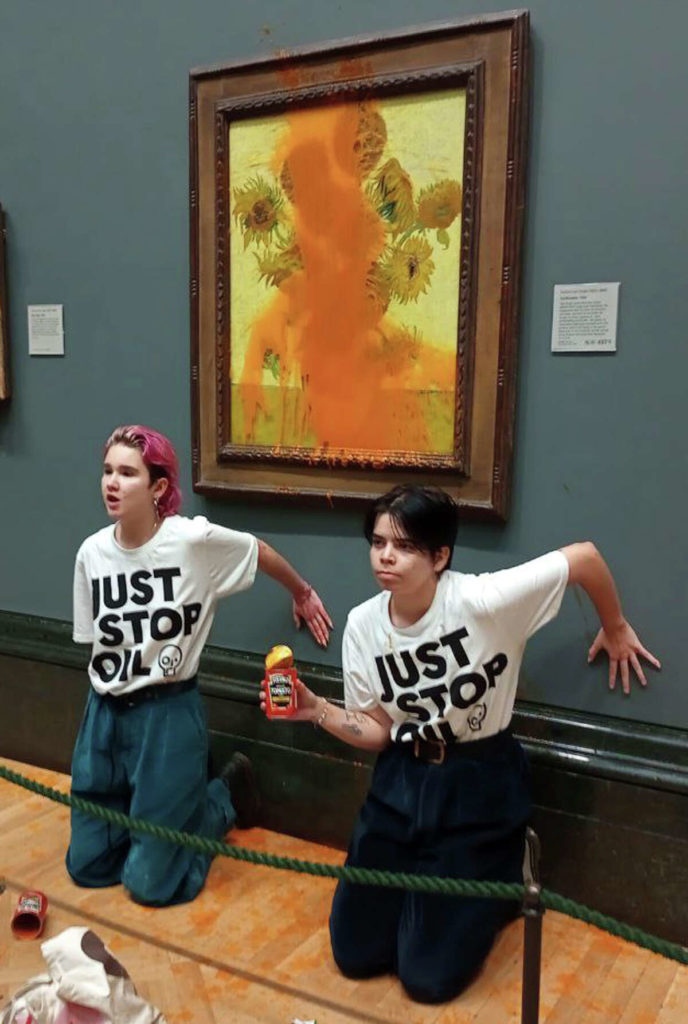
Last night, I watched a viral clip of Phoebe Plummer, the climate activist who received international attention for throwing soup over Van Gogh’s ‘Sunflowers’, confronting an interviewer for neglecting to report on the climate crisis. I had seen her been fairly widely labeled as a snowflake, as a performative activist, a virtue signaler, a member of the woke mob, and so on. Having seen the clip, I must commend her creativity. The painting was undamaged, and her actions certainly sparked conversation. At times, it feels as if we have become too accustomed to this worldwide decay–a constant, looming feeling of collapse. I remember checking my phone on a coffee break at my hotel job earlier this year to see that Roe V. Wade had been overturned, and that thousands of women were now at risk of having to carry unwanted pregnancies, no matter their circumstances. I woke up this morning to see that a man who passed away last month had won a seat in the US midterms. My news feed speaks of mass evictions in Dublin. Such and such a country is on fire. Cork is flooded. Somebody on my Facebook has opinions on vaccines and “Q”
There’s a certain fatigue that comes with this endless stream of misery, as well as the feelings of powerlessness that can come with it. It’s easy to fall into complacency when these anxieties become a part of everyday life. But, seeing Phoebe Plummer telling her interviewer that the news always makes time to show the sports highlights while downplaying impending catastrophe made me realise how easy it can be to tune it all out.
This was on my mind as I analysed the poetry of Mary Robinson, particularly “The Wintry Day” for my Romanticism and Modernity seminar. She contrasts mansions, silky chambers, people gathering around fires, singing, drinking, enjoying one another’s company, protected from the harsh conditions outside. Meanwhile, the poverty-stricken are left to freeze in “barren” hearths, braving the cruel force of nature. She paints comforting, joyful, domestic images before abruptbly ending these stanzas with “Ah! No!” and juxtaposing the wealthy’s celebrations with the grief and misery of the poor. The poor are isolated “in a cheerless nak’d room…where a fond mother famish’d dies” while the wealthy gather around “their shining heaps of wealth…sporting their senseless hours away”. Robinson exposes the massive disparity between classes as she describes how different members of society would experience the same day in Winter. The wealthy seem to possess little awareness of the conditions the poor are forced to face as they are exposed to the harshest conditions with little food or shelter. The oppositions between nature and culture, rich and poor, excess and barrenness are extremely striking and surprisingly relevant to today.
This poem written in the nineteenth century feels unsettlingly close to our current reality. It definitely brought me to wonder about my own role in all of this. Am I, like the wealthy citizens in Robinson’s poem, “senseless”? We are, of course, undeniably privileged in our ability to tune out negative news by switching off the television and deleting Twitter. What about those in the global South who are affected most, while the worst perpetrators–our friends Musk and Bezos, for example–propose ways to escape the planet that they helped to destroy? Transhumanism was another topic we discussed in class, but it feels so disturbingly cynical that our newfound ability to prolong our lives, play with the idea of consciousness, or explore new worlds, is being harnessed by the ultra-wealthy to transcend the consequences of their own actions.