Robotic Hounds, Othered Women and Sexy Ears… A Reflection on the Textualities Conference

My rants have been heard, the dust has settled and I have organised my thoughts enough to be able to reflect on last week’s Textualities Conference. I was lucky enough to witness a truly eclectic mix of presentations covering topics that were completely different from my own areas of interest. While the lineup had been split into four panels covering Character and Identity, Gender Rules and Expectations, Nature, Space and Place and Traces of the Gothic in History, there was huge variation even within these categories.

I initially decided to examine attitudes towards disability as reflected in 19th century horror and contemporary film. My main obstacle was choosing a focus and narrowing my topic down to fit the snappy ‘Pecha Kucha’ presentation format. I also have a tendency to ramble a bit because I find the topic so fascinating! I started by researching ableism in the Victorian era and relating my findings to the main text I had chosen, The Strange Case of Dr Jekyll and Mr. Hyde by R.L. Stevenson. The presence of the scientific in this novel and the implications of Mr Hyde’s corrupted form had always been striking to me since I first studied it in a Gothic Literature seminar during my undergraduate. In my presentation I linked the rise of Darwinist theory and increases in industrialisation to negative attitudes around disability in the 19th century. Disability scholars have highlighted Mr Hyde’s intangible deformity and “mark of decay” as he physically changes to reflect his alternate, evil personality, linking this to the Moral Model of Disability wherein physical disability is viewed as reflecting inner corruption. In the end I opted to compare this text to “Split”, dir. M. Night Shyamalan. In choosing two texts focusing on multiple personalities, I hoped to highlight how attitudes towards disability and mental illness have changed over time, although they may not necessarily have entirely improved. I had already done a considerable amount of reading into ableism in modern horror, so I encouraged the audience to ask about this as I had a lot more to say than could be fit into a six minute talk!

During the day, I learned about the grotesque in short stories, the greenhouse and colonialism in Romantic texts, Arthur Conan Doyle as a Naturalist and Murakami’s love of ears. There was a real sense of pride at the end of the day, having seen the culmination of my peers’ research condensed into short talks that were infomative, fascinating, hilarious and even shocking. The Pecha Kucha style was a daunting but welcome challenge and the ideas I encountered in preparation will doubtlessly help in my thesis research. I have a lovely sense of accomplishment and the day has certainly set the pace as we brace to begin writing for our theses.

Some Thoughts on the Public, Private and Pandemic in Pearl (2022)

October has come and gone, and it’s safe to say that I have consumed my fair share of horror films over the last week or so. I would like to say that I have developed a fairly strong stomach when it comes to horror–Midsommar and Silence of the Lambs are two of my favourite films of all time–but Ti West’s Pearl is unsettling in a different way. The Gothic has been one of my research interests from the very beginning of my academic journey; something about the macabre in literature has always been appealing to me.

The titular character is a young woman born to German immigrant parents, who must tend to their farm while her husband is overseas fighting in WWI. Pearl’s mother is controlling and repressive, and Pearl is limited by her duties of managing the farm and caring for her disabled father. The main character’s Southern drawl, modest personality and girlish appearance make her appear deceptively innocent. However, there is a disturbing disparity between her actions in public and the desires she exhibits when nobody is watching.

The film presents several contrasts to the audience throughout; public and private, repression and sexuality, tradition and progression. Pearl desires to move past her humble origins, desperate to be seen for what she believes she is: a star. She becomes fixated on “the pictures”, fascinated by the dancers she sees in her local cinema. The resident projectionist introduces Pearl to pornography, assuring her that it is soon to become legal and that she, too, could be on screen someday. In one of the more unsettling scenes of the film, Pearl goes home and simulates intercourse with a scarecrow, all the while fantasising about the projectionist. This is not the first time the protagonist is seen engaging in unusual and disturbing behaviours in private, speaking to her farm animals as if they were human and killing them when she feels they have insulted her or misbehaved. When Pearl’s controlling mother confronts her for leaving the house, Pearl murders her, showing her new, disturbingly defiant character.

It would be impossible to mention the backdrop of the influenza pandemic presents without relating it to the ongoing covid pandemic. Pearl’s mother witholds food once she discovers that she has been to town, putting her father at risk. There is a feeling of isolation present throughout; the cinema is sparsely attended, and background characters are seen walking alone with their faces covered. One particular shot, where Pearl is watching a film, alone, and slips down her mask to eat, feels so mundane, but so unnervingly relevant to today, that it honestly caught me off-guard.

The most memorable scene of the film occurs when Pearl attends an audition to join a dancing group. Her dream of moving beyond her isolated life on the farm finally feels within reach, and she obsesses over her routine in the hopes that she may become like the dancers she admires in the cinema. However, when Pearl is rejected, she suffers a breakdown, screaming at the judges that she is a star and having to be escorted away. Not only has she suffered the heartbreak of missing out on her dream of being on the screen, Pearl fears that this rejection has condemned her to waste away on the farm for the rest of her life. In a striking monologue, Pearl reveals to her sister-in-law, Mitsy, that she has always felt different from others due to her inner feelings and desires, and that she resents her husband so much for leaving her on the farm that she wishes he would die. It is the most clarity the audience sees from the protagonist, who is prone to fits of violent rage, which lead her to murder her parents and the projectionist. Mia Goth’s performance here feels honest and even sympathetic, with this monologue bringing a sense of depth to Pearl’s character. After revealing her despair, Pearl brutally murders Mitsy with an axe after becoming falsely convinced that the judges chose Mitsy over her.

https://www.youtube.com/watch?v=Y1CbJlbafXQ

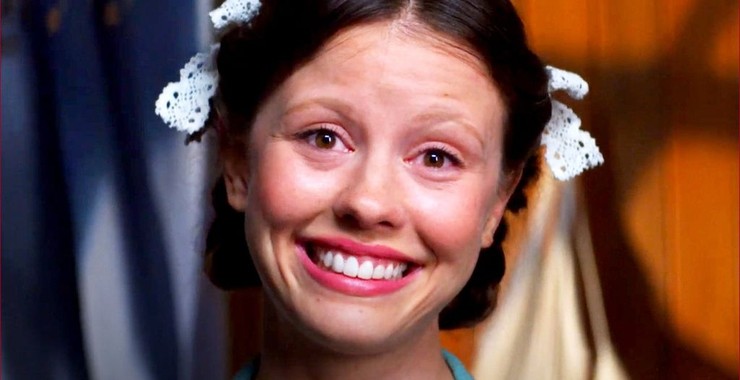
The final scene, where Pearl’s husband returns home, feels like the ultimate defilement of the domestic space. He finds a feast of rotting food, with Pearl’s deceased parents seated at the table. The final image feels like a corruption of the traditional image of the nuclear family, perhaps as if to say that the old way of living has been done away with? Perhaps, in her disturbed mental state, the main character is finally attempting to perform the role of the housewife, but has become too detached from reality. Pearl comes to greet him, and the film ends on an extended close up shot of her strained, tortured smile.

I may revisit this film in my writings–it is still very fresh, so there is no doubt that there will be further discourse on the role of the domestic space, generational differences in early 20th century America and the role of sexual desire in the film. I know for sure that it’s a film I won’t be forgetting about anytime soon.